 Mituda
Georgian food is organised by region, and that is not a guidebook formality. Mingrelian cooking is noticeably spicier than the rest, Adjarian leans Turkish, and the mountains have almost no vegetables but serve meat and cheese in quantities the lowlands would consider excessive.
So the question of what to try is better asked together with where. Both are below.
Khachapuri: there are several, and they are different dishes
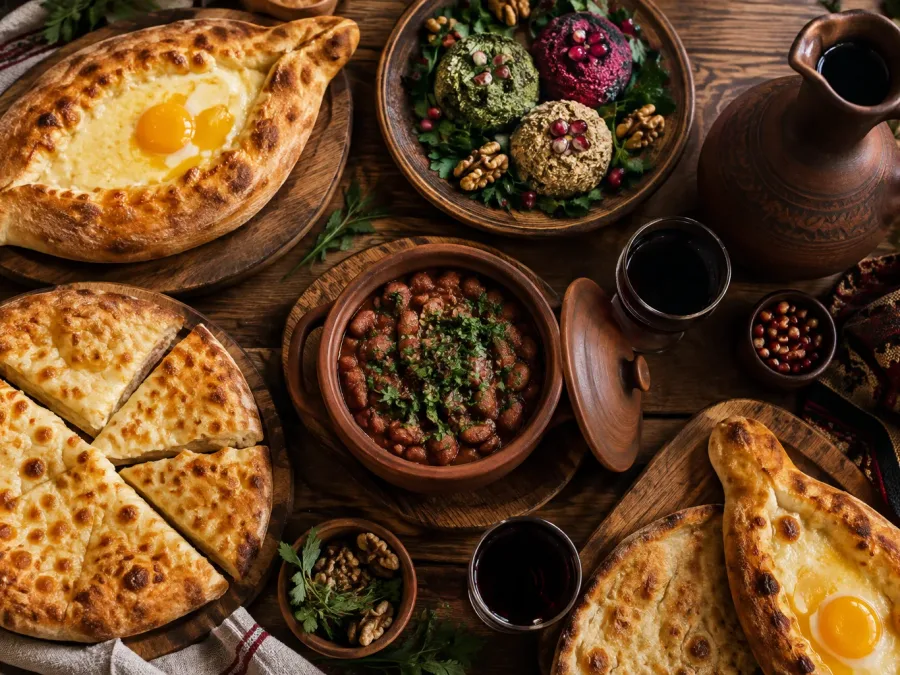
One word, at least four dishes. Anyone who has only had the Adjarian one knows almost nothing about khachapuri.
- Imeretian — a round closed flatbread with cheese inside. The base form the others grew from, from Imereti and Kutaisi.
- Megrelian — the same, with another layer of melted cheese on top. From Samegrelo, and richer there than anywhere.
- Adjarian — an open boat of dough with cheese, a slab of butter and a raw yolk in the middle. From Adjara, and in Batumi it genuinely tastes different.
- Penovani — puff pastry, triangular. Usually bakery street food rather than a restaurant dish.
Khinkali
Large dough pouches with meat and broth inside. The order of operations matters, and it is not ceremony but practice: there is genuinely hot liquid in there.
- Pick them up by hand, holding the knot. Do not pierce them with a fork: the broth runs onto the plate and the point of the dish is gone.
- Bite the side and drink the broth first.
- Then eat the rest. The knot is not eaten — it stays on the plate, and the knots are how you count who had how many.
Starters
- Pkhali — a cold starter of chopped vegetables with walnut and spices: spinach, beetroot, aubergine, nettle. Order the assortment; the difference between them is real.
- Badrijani — fried aubergine rolls with walnut paste and pomegranate.
- Lobio — beans stewed with spices, usually in a clay pot, served with mchadi corn bread and pickles.
- Ajapsandali — a vegetable stew of aubergine, pepper and tomato, served hot or cold.
Mains
- Chashushuli — beef stewed with tomatoes and hot pepper.
- Ojakhuri — fried meat with potatoes, served in the pan.
- Shkmeruli — chicken in garlic and cream, from Racha. There is more garlic in it than you are probably expecting.
- Satsivi — chicken in a cold walnut sauce. A winter dish, above all at New Year and Christmas; rare and worse in summer.
- Kuchmachi — offal with walnut and pomegranate. An acquired taste, but worth one try.
Wine
The main thing to know about Georgian wine fits in one sentence: in Kakheti it is made in qvevri — clay vessels holding several hundred litres, buried in the ground up to the neck.
The grapes go in whole, skins and stems included, and stay for months. The method is on the UNESCO intangible heritage list, and it is not a reconstruction for visitors but ordinary working practice at hundreds of estates.
See what runs: tours.
Sweets and drinks
- Churchkhela — nuts threaded on a string and dipped many times in thickened grape juice. The real thing is firm, dark and has no added sugar. Soft and bright pink usually means sugar and dye.
- Pelamushi — a thick grape pudding from the same juice, served cold.
- Chacha — grape spirit. Homemade almost everywhere and stronger than it looks.
- Borjomi — mineral water with a marked saltiness. In Borjomi itself it is drunk warm straight from the spring, and it is a completely different drink from the bottled one.
Where to eat
A simple rule that holds almost without exception: the further from the main tourist street, the better and cheaper.
- In Tbilisi — the districts outside the Old Town: Vere, Marjanishvili, Avlabari.
- In the regions — roadside places with local drivers’ cars parked outside. The most reliable indicator there is.
- In the mountains — family guesthouses. They cook home food, and it is often the best thing you eat all trip.