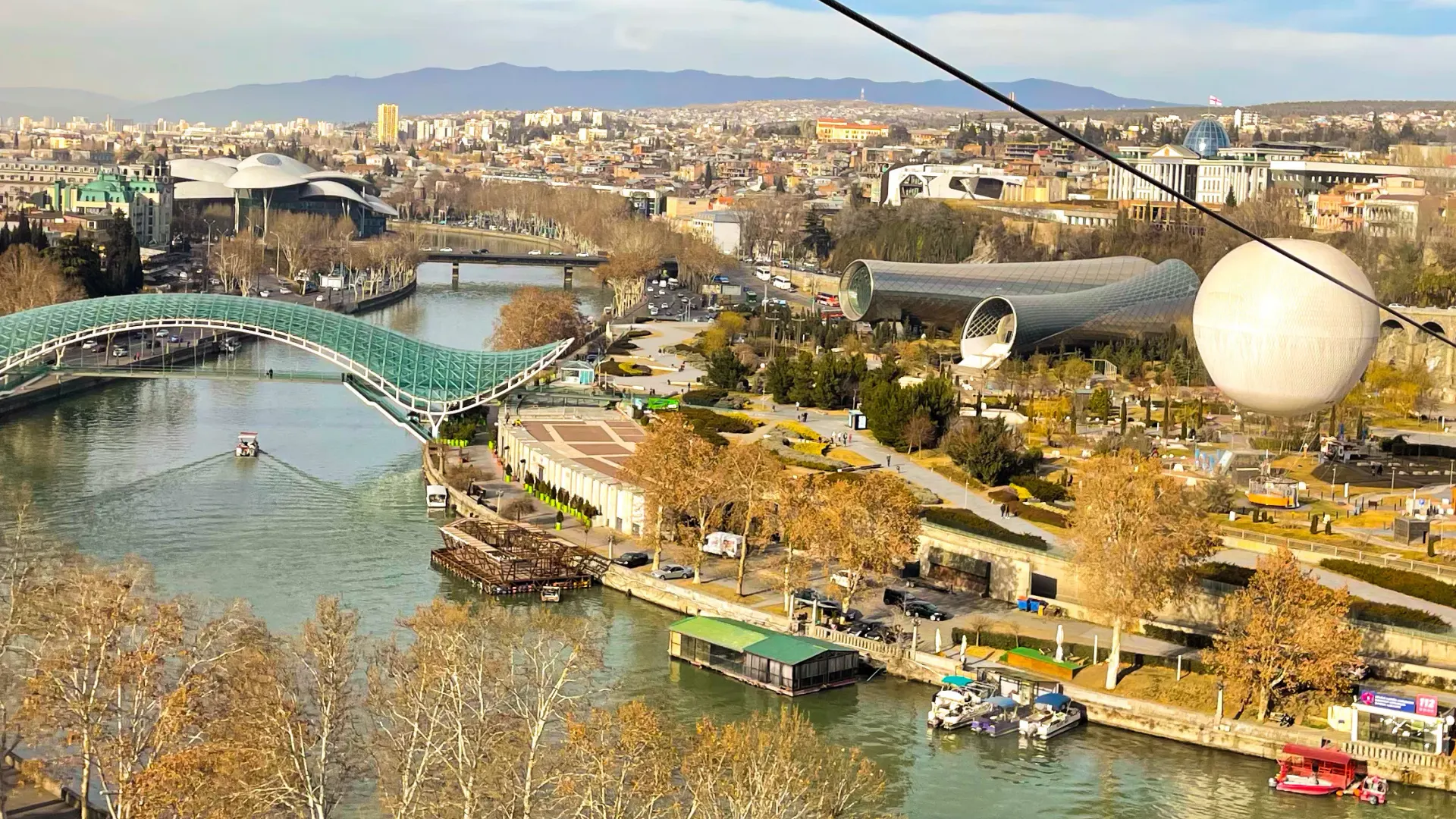
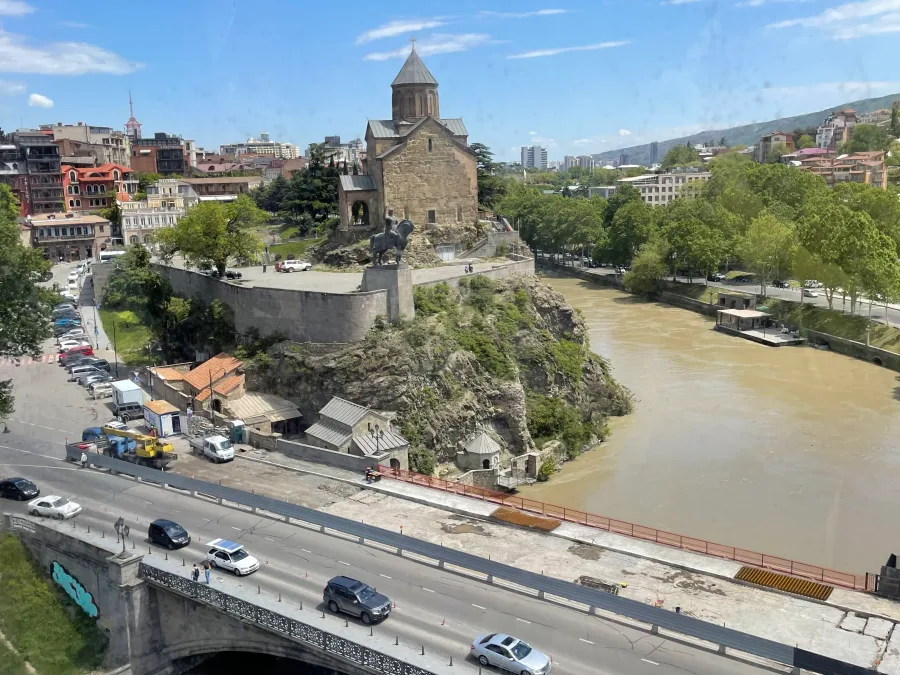
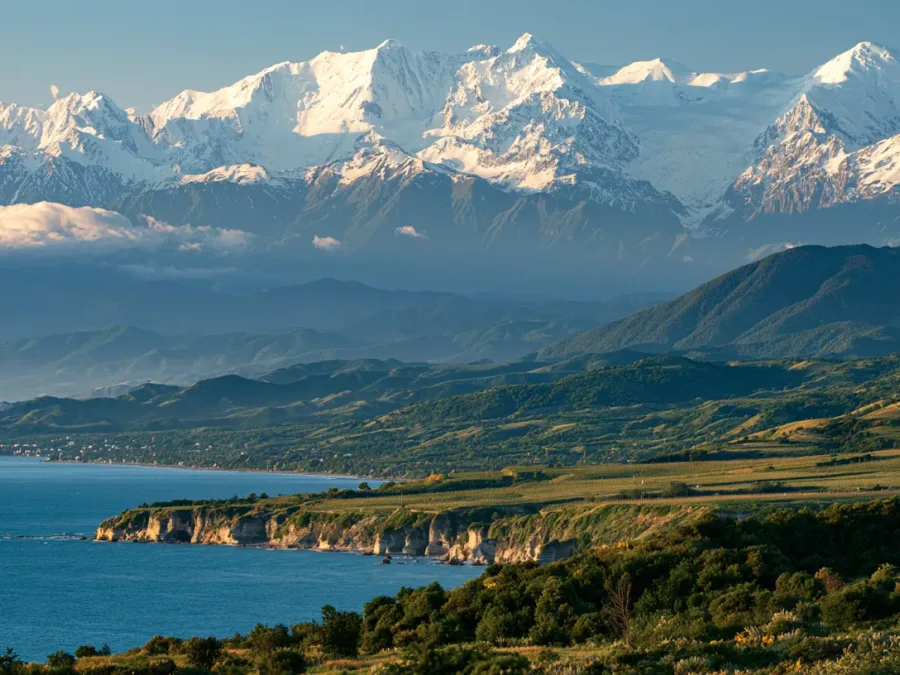
Tbilisi sits on the Kura in a narrow valley pressed between hills on both sides. Hence its defining feature: the city climbs in terraces, and map distance correlates poorly with effort. Four hundred metres between two points can turn out to be forty metres of staircase.
It was founded in the 5th century around hot sulphur springs, and that is not a story for visitors: the springs still run, a whole quarter of bath houses stands on them, and the sulphur in Abanotubani is noticeable from the street.
What to see
The list below is about a day and a half at an unhurried pace. With one day, take the first three and go up Mtatsminda in the evening.
The Old Town — narrow lanes on the slope below the fortress, carved wooden balconies, churches of different faiths three minutes apart.
Narikala Fortress — founded in the 4th century and rebuilt many times. A cable car runs up from Rike park; walk down through the Botanical Garden.
Abanotubani sulphur baths — brick domes pushing out of the ground. A bath is hired whole by the hour, not by the seat.
Rustaveli Avenue — the Rustaveli theatre, the National Museum, parliament. The museum earns its time for the Golden Fund: Colchian goldwork from the 3rd to 1st centuries BC.
Mtatsminda — a funicular, a park with a Ferris wheel and the whole city from above. Go at sunset.
Sameba Cathedral — consecrated in 2004, visible from almost anywhere in the city.
The Dry Bridge — a flea market where Soviet optics, enamel and porcelain turn up among the junk.
The Tbilisi courtyard
One thing deserves its own mention, and it is what makes people come back: the courtyard. A typical Tbilisi courtyard is a shared wooden gallery to the first floor, a vine overhead, somebody’s laundry drying, a couple of cats and almost always an open gate.
You find them on Betlemi, in Sololaki, around Amaghleba street. They have not been restored, and that is exactly why they are real: peeling paint, a creaking staircase, an early-century stained glass window in the entrance with one pane missing. In ten years half of them will be tidied up and considerably duller.
Districts: what is where
Tbilisi is poorly described by a list of sights and well described by a list of districts. They genuinely differ, and where you stay shapes your impression of the city more than which hotel you pick.
Sololaki — the quarters below Narikala, with the finest courtyards and stained-glass entrances. Quiet, expensive, a lot of stairs.
Abanotubani and the Old Town — baths, narrow lanes, tourist density. Beautiful, but noisy in the evening.
Vera — a calm district between the centre and the park, with cafes and bookshops and a local crowd.
Marjanishvili — the left bank, large Soviet blocks, the best cheap places to eat and a market nearby.
Avlabari — the historic Armenian quarter below Sameba cathedral, with a good view across the river.
Chugureti — an old district slowly coming back to life with workshops and galleries, still free of tourists.
Getting around
The metro has two lines, runs deep and fast, and is paid with a transport card sold at any station. Taxis are cheap, but order them through an app rather than off the street: hailed on the street the price is guessed, and almost always higher.
The centre walks end to end, but remember the terrain: the climbs here are real, and in the middle of a summer day you feel them.
Worth knowing
Cash. Cards work almost everywhere, but the market, minibuses and small places want lari.
Water. Tap water in Tbilisi is drunk as it comes; it is from mountain springs.
Heat. In July and August, eleven to seven outdoors is hard work. Plan museums and baths for those hours.
Shoes. Cobbles, stairs and gradient. Elegant footwear loses to the first walk.
Dogs. There are many street dogs with a tag in one ear — a city programme: vaccinated, neutered and usually calm.
Day trips from the city
Mtskheta — 20 minutes. The ancient capital, Svetitskhoveli cathedral and Jvari monastery, both UNESCO sites. Half a day.
Kazbegi — 3 hours. The Military Road, Ananuri, Gudauri, Gergeti church. A full day.
Kakheti — 2 hours. Sighnaghi, Bodbe, the wineries. A day.
Gori and Uplistsikhe — an hour. The Stalin museum and the cave town. Half a day.
The international airport is 17 km from the centre, with a city bus and taxis. From Batumi it is about five hours by train or roughly six by road; the train is easier because it keeps a timetable while the motorway backs up in summer. From Kutaisi it is three to four hours by car.
Inside the city a car is unnecessary and mostly a nuisance. The metro works, taxis are cheap and the centre is walkable.
When to go
April, May, September and October are warm without the heaviness, and that is the best window. In July and August the city can reach forty degrees, and walking really only works before eleven and after seven; the rest goes into air conditioning.
Winters are mild and snow rarely lasts. The city is empty and cheap then, which is a fair option if Tbilisi itself is the point rather than the mountains: the passes are already closed or unreliable.
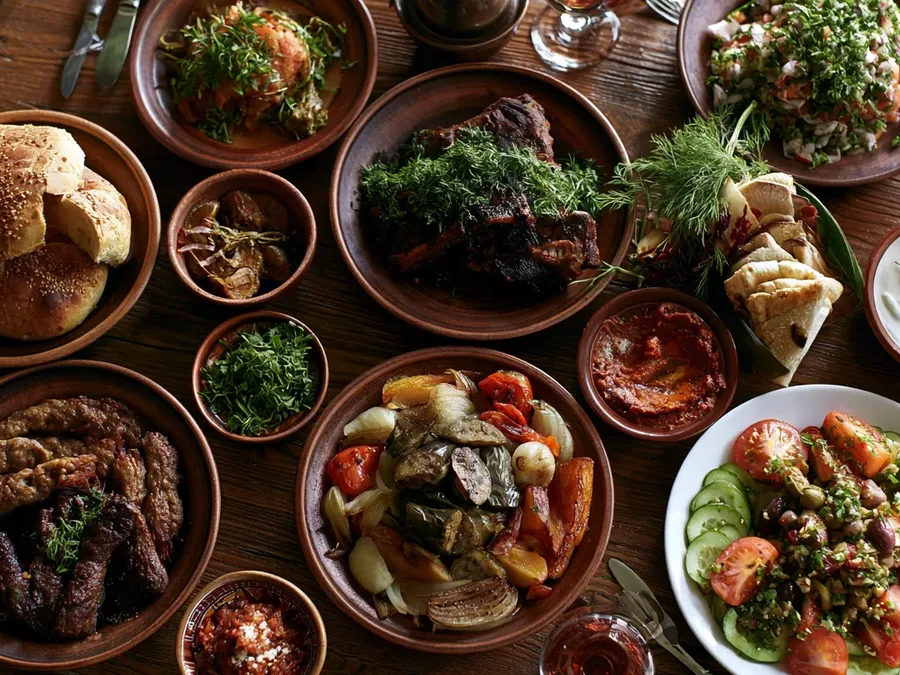
Khachapuri in Batumi and in Kutaisi are two different dishes with one name. Khinkali are eaten by hand in a set order, or the broth ends up on the table. And a "dry white" in Kakheti is not the drink you were expecting. What to order, how to eat it, and where it will be the real thing.
A ready week with one base and four day trips. You unpack once, everything worth seeing is within three hours, and the seventh day is deliberately left empty. Here is why, and how to reshape it if you fly into Kutaisi.
A country you can drive across in a day, where four hours take you from the beach to a glacier. And where a week covers about a quarter of what you planned. A breakdown by region: what to see, how many days it honestly takes, and where people miscalculate.
 Mituda