 Mituda
The most common mistake when planning a week in Georgia is trying to get everything at once: mountains, sea, wine and Svaneti. The plan looks full; in practice five of the seven days happen in a car, and by day four the sights blur into one.
The route below works differently. A base in Tbilisi with day trips out. Everything you see is within three hours, and in the evening you go back to the same flat instead of hunting for another bed.
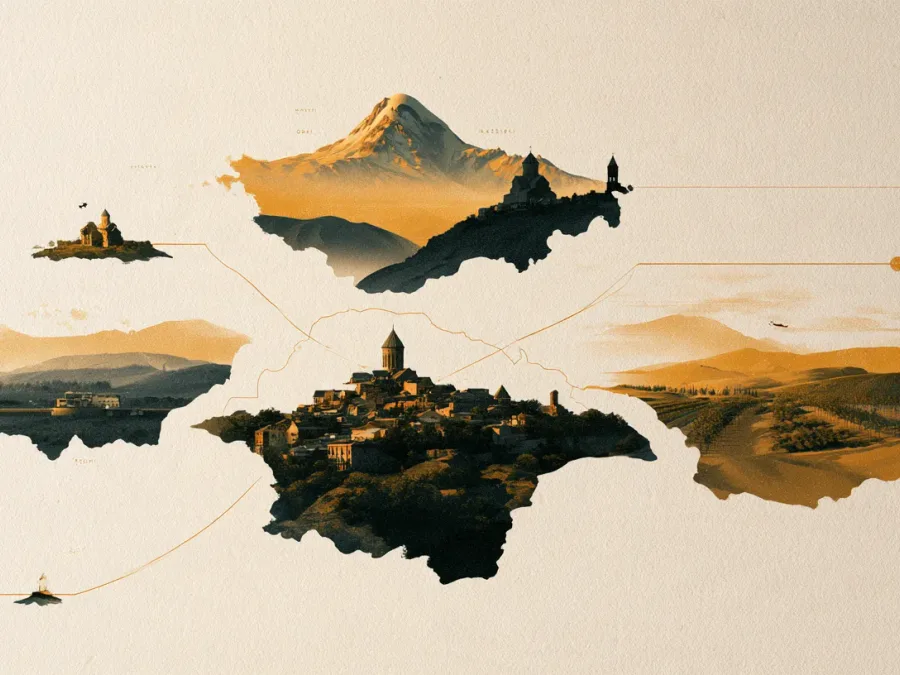
Day 1. Tbilisi
Arrival and the city without a car — in Tbilisi it mostly gets in the way: parking is scarce, traffic is dense, and the centre walks comfortably.
The Old Town, the Abanotubani sulphur baths, the cable car up to Narikala from Rike park. Walk down through the Botanical Garden instead of riding back: you will see the side of the city nobody puts on a postcard.
In the evening, Mtatsminda for the whole city from above. If you land early and still have energy, add Rustaveli Avenue and the Dry Bridge flea market.
Day 2. Mtskheta and Ananuri
Half a day in Mtskheta: the 11th-century Svetitskhoveli cathedral, built on the site of the country’s first Christian church, and the 6th-century Jvari monastery on the hill above the meeting of the Aragvi and the Kura. Both are UNESCO World Heritage sites.
From Jvari you can clearly see the two rivers running side by side in two different colours. Go up in the morning: by midday it is both hot and crowded.
Twenty minutes on is Ananuri fortress, 16th to 17th century, on the Zhinvali reservoir. In May the water is turquoise and high; by September it has dropped noticeably, exposing the banks.
Day 3. Kazbegi
The longest day of the week and the most spectacular. A hundred and fifty kilometres up the Georgian Military Road, and nearly every stop on it earns its time.
- Pasanauri — where the White and Black Aragvi meet and run side by side for a while without mixing.
- The Friendship of Peoples arch — a 1983 concrete half-ring with a mosaic, hanging right over the drop at the Jvari pass.
- Gudauri — a ski village at two thousand metres; in summer the paragliders launch here.
- The Jvari pass — 2,379 metres, the highest point of the road.
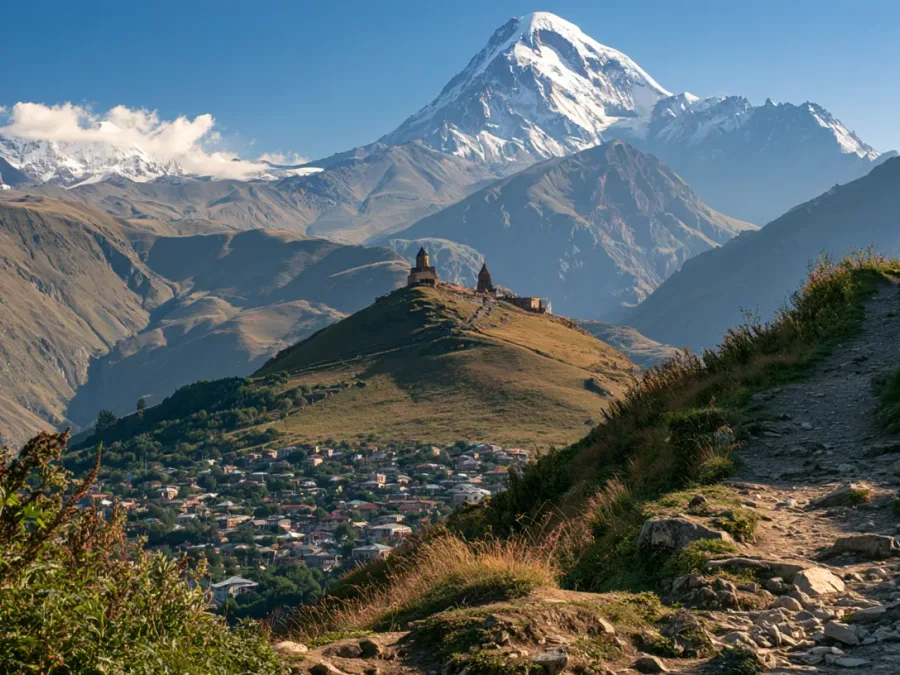
- Gergeti Trinity church — 14th century, 2,170 metres, Kazbek behind it. The finish.
A mountain dirt road and a footpath of about an hour and a half lead up to the church. The path is hard work, but walking at least part of it is worth it: the view from the road is a different thing entirely.
More: Kazbegi.
Day 4. Tbilisi, a breather
After Kazbegi you need a slow day, and it is not lost time but the condition for spending the remaining three days as a functioning human being.
Museums, the Vere district, the Dezerter bazaar with its cheeses and spices, lunch around Marjanishvili. Or a thermal bath, which after a twelve-hour mountain day works better than any excursion.
Day 5. Kakheti
Two hours to Sighnaghi — a town on a hill above the Alazani valley, ringed by an 18th-century wall with twenty-three towers. The town itself takes two hours, but on a clear day the whole Caucasus range is visible from the ramparts and leaving gets difficult.
The 9th-century Bodbe convent is next door, where Saint Nino, who brought Christianity to Georgia, is buried.
Then the wine part. Estates across the valley range from large plants with scheduled tours to family cellars with a dozen qvevri that let you in off the yard. The second is more interesting but needs either a driver who knows whose gate to stop at, or an address written down in advance.
Day 6. Gori, Uplistsikhe and Borjomi
West along the motorway. An hour to Gori: the Stalin museum, opened in 1957, with the house where he was born and his personal railway carriage.
Twenty minutes on is Uplistsikhe, a cave town cut into the cliff above the Kura around the first millennium BC. Halls, streets and a theatre carved straight into the rock. There is no shade at all, so in summer go before noon.
Another hour and a half brings Borjomi: the central park with a pump room where the mineral water is drunk straight from the spring. It is warm and distinctly salty, nothing like the bottled version; half the people who try it do not like it, which is normal. A cable car runs from the park up to the plateau.
Day 7. Spare
Better to leave the last day open, for three reasons.
- By day seven you usually know what was missing: back to Kakheti for the wine, out to Vardzia, or simply staying in Tbilisi and walking the Old Town once more.
- It is insurance. A mountain trip can fall through on weather, and a spare day turns a ruined plan into a moved one.
- Not rushing before a flight is worth something on its own.
How to reshape it
If you fly into Kutaisi — where most cheap flights from Europe land — it makes more sense to start in the west: three days for Gelati, Prometheus Cave and Martvili canyon, then move to Tbilisi for the remaining four days above.
If you want the sea, the move to Batumi is six hours by road or five by train. The train is easier: it keeps to a timetable, while the motorway backs up in summer.
Rental or driver
In Tbilisi itself a car is unnecessary. For the day trips there are two options, and they differ not in price but in who makes the decisions on the road.
One note on Kakheti: if the day involves tasting at two or three estates, driving is off the table and the rental question answers itself.
See what is available: tours, transfers. How booking works: the short version.